

TFaQ Terme Felici ad Aquileia:
Research
TFaQ Terme Felici ad Aquileia:
dai depositi al Virtual-Visual Storytelling
Responsabile scientifico: Matteo Cadario
Archivio digitale
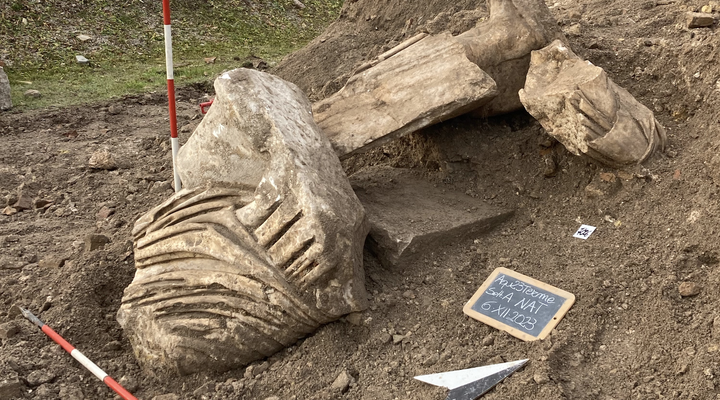
The project TFAq – Terme Felici in Aquileia: from Deposits to Virtual-Visual Storytelling focused on the virtual reconstruction of the decorative and sculptural apparatus of the Great Felician Baths of Constantinian Aquileia. Through 3D documentation and analysis of the most significant architectural and sculptural fragments, the project aimed to create a digital archive to support a virtual reconstruction of the baths’ elevations and interiors. The work was designed to enhance the study, valorization, and dissemination of the excavation results.
Objectives
- Acquisition of 3D scans of architectural and sculptural elements via LIDAR.
- Creation of a digital archive of scanned fragments, including photographs, georeferenced location, materials, conservation state, dimensions, and traces of workmanship.
- Petrographic, mineralogical, and geochemical characterization of selected fragments to identify marble types and reconstruct the decorative color scheme.
- Integration of aerial imagery and spatial documentation to support a virtual-visual reconstruction of the baths.
Results in the field of DH
- A total of 82 fragments (70 architectural, 12 sculptural) were documented, catalogued, and uploaded to the E-Dvara platform, providing a comprehensive tool for study and virtual access to the decorative apparatus.
- Petrographic analyses of 20 selected fragments identified white marbles (Proconnesian, Thasian, Parian, Pentelic) and colored litotypes, confirming the imperial patronage and high-quality materials of the Great Baths. Further analyses are ongoing for rarer marbles such as Latmos.
- Evidence of architectural and sculptural reuse was documented, including a figurative capital with oriental prisoners, demonstrating selective reuse to convey imperial symbolism. Most sculptural fragments are re-used, consistent with late antique construction practices.
- The project enabled enhanced virtual storytelling, combining 3D scans, georeferenced fragment locations, and aerial imagery from drone surveys.
Publications
- M. Cadario, M. Rubinich, Riuso dell’edificio e reimpieghi di materiali alle Grandi Terme di Aquileia: lo stato della questione, in P. De Vingo (Eds.), Il riuso degli edifici termali tra tardoantico e medioevo. Nuove prospettive di analisi e casi studio, Firenze 2025, 63–80 (forthcoming).
- M. Cadario, C. Tiussi, Nuovi frammenti scultorei dalle Grandi Terme di Aquileia, forthcoming.
- M. Rubinich, S, Magnani, Un nuovo frammento epigrafico reimpiegato come blocco architettonico dagli scavi delle Grandi Terme di Aquileia, forthcoming.
Related Events
11–12 December 2025 |
Image: Discovery of three statues, © Project TFaQ