

Medici e medicina sulla scena attica tragica e comica (Scen_Med_Lab)
Research
Medici e medicina sulla scena attica tragica e comica (Scen_Med_Lab)
Responsabile scientifico: Elena Fabbro
In collaborazione con il laboratorio
HISOMA – History and Sources of the Ancient Worlds, Université Lumière Lyon 2 e con RIMA – Centro di ricerca interdipartimentale per la medicina antica
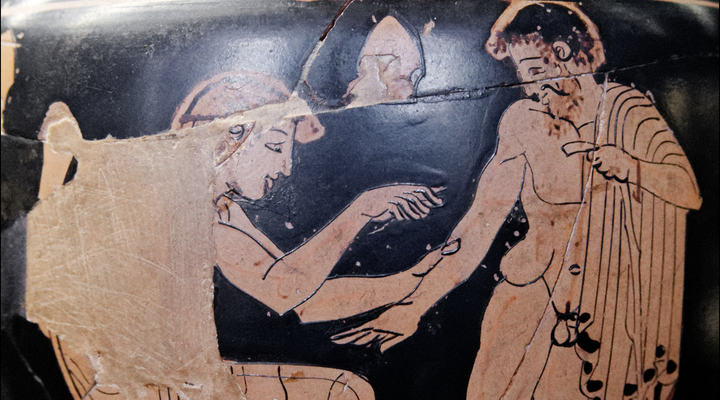
The project stems from the systematic collection of passages in Greek comedy in which themes related to medicine appear, identifiable through the use of technical or specialised vocabulary. Based on this foundation, the investigation was extended to the tragic corpus of the 5th and 4th centuries BCE, with the aim of exploring the presence and role of medical knowledge — anatomical, physiological, pathological, and therapeutic — within the ancient theatrical genres.
Objectives
The collection of passages was conceived primarily as a historical-literary repertoire useful for interpreting the content and influences of the theatrical genre, but also as a repository for the subsequent transfer of lexical and thematic data into an open-access virtual environment.
The survey highlighted that in Aristophanes there recur numerous terms, notions, and ideas closely aligned with those employed by Hippocratic physicians, such as: attention to life stages; observation of evacuations; identification of a relationship between evacuations and diet; knowledge of organs and vital functions; phenomena specific to women (fertility, sterility, and pregnancy); principles of generation; the doctrine of the winds; pathologies of various kinds, e.g., ophthalmic, traumatic, osteo-articular, dermatological, and psychological (within the theoretical framework of the humoral system); the use of foods for therapeutic and culinary purposes; baths; simples; and surgical treatments (notably bandaging and cupping). Considering that Aristophanes was a contemporary of Hippocrates and that the poet did not intend to reference the physician’s doctrine in his work, the material should rather be regarded as a valuable documentary source on principles and notions concerning bodily health and disease pre-existing rational Hippocratic medicine, later developed with the tools and language specific to a techne.
In the representative production of the mese — so far little studied for its links with medicine — particular interest arose in the surviving work of Alessi of Turi, who mentions various body parts and refers to humoral theory, especially concerning the nature of bile, which varies in characteristics between male and female subjects. Notably, fr. 195 K.-A. attests to the comic poet’s knowledge of the relationship between the perception of odours and their processing by the brain via respiration, theorised by the Pythagorean philosopher Alcmaeon of Croton. Alessi, like other poets of the mese, also displayed interest in the figure of the physician — introduced into the plots in this phase of comedy — and in psychological illness as a source of human suffering and disorders of thought and behaviour. With the mese, attention to diet also intensified, particularly the eating habits of philosophers, long a subject of observation and critique by comic poets.
In the works of Menander, the passages relevant to this research concern anatomy and physiology to a lesser extent — primarily invoked for the more “human” aspects of the body and life, such as breastfeeding — and pathology to a greater extent. In this author, knowledge of humoral physio-pathology reaches its peak, with particular interest in the psycho-physical consequences of humoral imbalance as constitutive elements of the body: Menander shows special attention to black bile — a fluid of uncertain identification, considered responsible for depressive as well as irascible manifestations — and examines the state of the melancholic patient comprehensively, allowing comparison with contemporary and even later medical sources. From a young age, Menander was familiar with and adhered to the doctrines of the Peripatetic school, and it is known that melancholy was addressed by the school, particularly by Theophrastus. However, it seems prudent to consider that the medical content in his work develops in parallel with the advances and trends of medicine, which in the Hellenistic-Roman period began to investigate interior aspects of the body and life, such as the mind and soul.
Results in the field of DH
- Survey of Greek comic texts in available editions and commentaries, and linguistic-stylistic analysis of the passages identified based on the presence of significant terms;
- Interpretation of poetic and theatrical contexts in order to assess the function of the chosen terms;
- Compilation of dossiers containing the results of the analysis, enabling the reconstruction of the historical relationship between comedy and medicine for subsequent publication;
- Extraction of key terms in view of the potential creation of a digital tool, to be hosted in a virtual environment, allowing storage and consultation of the data resulting from the research activity (Comm_Med_Lab).
Publications
- A. Monte, Recording Medical Recipes on the Back of Papyrus Documents: A receptarium from the British Library, Zeitschrift für Papyrologie und Epigraphik 233 (2025) 143–162.
- A. Monte, Medicine per corrispondenza: due papiri viennesi rivisitati (MPER N.S. XIII 6 e SB XXVI 16455), Zeitschrift für Papyrologie und Epigraphik 233 (2025) 163–168.
- A. Monte, I colori dei farmaci antichi: l’ "impiastro grigio Egizio" nella letteratura medica e in un ricettario su papiro, Aegyptus 105 (2025) 87–100.
- A. Monte, A Life in Fragments: The Physician Heras of Cappadocia and His Narthex between Indirect Tradition and Papyrus Evidence, Symbolae Osloenses 98 (2024) 24–47.
- Ch. Savino, Una glossa aristofanea nel lessico di Eroziano (κ 9; σ 5): problemi di tradizione ed ecdotica, Galenos 15 (2021) 15–26.
- Ch. Savino, Corvi e adulatori. Attestazioni e origini di un antico detto greco, Aion 43 (2021) 1–15.
- Ch. Savino, Galeno e la fortuna della commedia attica, Technai 12 (2021) 25–43.
Related Events
23 and 28 March 2023 |
12–13 September 2024 |
13 September 2024 |
Image: Marie-Lan Nguyen (2011) – CC BY 3.0