

Economia e politica sulla scena ateniese del V e IV sec. a.C.:
Research
Economia e politica sulla scena ateniese del V e IV sec. a.C.:
opinioni e atteggiamenti mentali (EcoPolis)
Responsabile scientifico: Elena Fabbro
in collaborazione col gruppo di ricerca Théâtre et cité, CRHEC, Université Paris Le Creteil (UPEC).
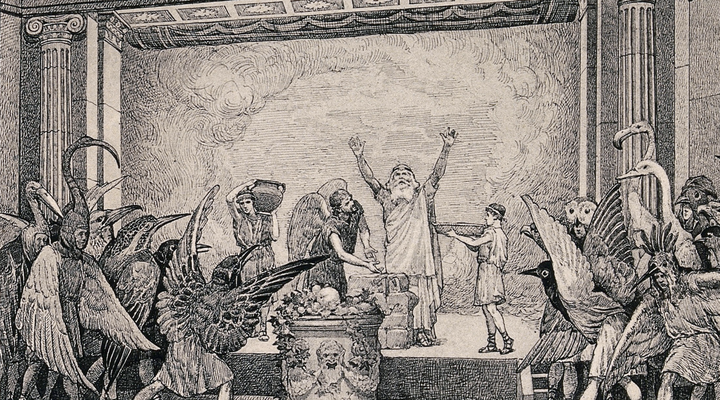
Even though largely concerned with events set in the remote past of myth or with imaginary stories, ancient Attic theatre is a theatre of and for the polis — it is a political theatre. Performed before the entire Athenian community gathered in the theatre, classical drama served as a powerful instrument for discussing and re-evaluating common identity and the issues connected to it. Archaic comedy, in particular, directly addresses the pressing political and social issues of the polis; yet tragedy is no less closely connected to its own contemporary context. Thus, the surviving dramas — whether complete or fragmentary — provide a reliable reflection of the social, political, and cultural milieu that produced them. For this reason, they are an extremely effective source for reconstructing contemporary mentalities; conversely, a focus on socio-political themes and their theatrical treatment allows a better understanding of these texts.
Objectives
The research examined, through the tools of topic modelling, how economic and political themes were treated on the tragic and comic stage of the fifth and fourth centuries BCE. While applying sentiment analysis methods to the corpus of ancient Greek theatre proves difficult for at least two reasons — the corpus is too limited to meaningfully affect quantitative metrics, and the poetic nature of language is inherently ambiguous and polysemous, often preventing discrete positive/negative attribution to specific terms — it is nonetheless possible to study economic and political vocabulary, both cross-sectionally (across the entire corpus, comprising 44 complete texts, including tragedies, comedies, and satyr plays) and in more focused analyses of individual authors and sub-corpora.
Results in the field of DH
The investigation revealed a strong concern in both tragedy and comedy for politics and economics: a rich lexicon used not only metaphorically but also literally. In particular, in the political domain, the following areas were analysed:
- geographical origin and ethnicity;
- power, the city, and its institutions;
- citizenship;
- colonisation;
- deliberation;
- law and justice;
- exile;
- oaths;
- supplication;
- war and peace.
In the economic domain, theatre explored the following topics:
- wealth and poverty;
- money;
- objects;
- buying and selling, commerce;
- lifestyles;
- labour and techniques;
- wages;
- agriculture and animal husbandry;
- public finance.
The study concluded with the creation of a tool for mapping economic terminology, based on a dual lexical and thematic coding system, which allows users to conduct both simple lemmatic searches and progressively deeper investigations into the various perspectives developed on specific socio-economic themes and dramatic techniques (poetic and theatrical function).
Publication
- F. Morosi, Eschilo. Eumenidi. Edition, introduction, commentary, Pisa, forthcoming (with G. Paduano).
- F. Morosi, Origini eterne: spazio, memoria, eziologia nel teatro antico, in E. Rosamilia, G. Proietti (Eds.), Prospettive ateniesi su storia, spazio e memoria, Perugia, forthcoming.
- E. Fabbro, Politique et symposium dans les Guȇpe d'Aristophane, Paideia (2026) 1–34 (in peer review).
- E. Fabbro, Le sfide della divinazione nelle commedie di Aristofane, Maia, 77 (2025) 303–332.
- E. Fabbro, Ifigenia tra i Tauri di Euripide tra distanze e integrazione, OT, 18 (2025) 95–125.
- E. Fabbro, Chapter 13: Peace and War, in M.C. Farmer, J.B. Lefkowitz (Eds.), Blackwell Companion to Aristophanes, Hoboken (NJ) 2024, 165–182.
- F. Morosi, Aeschylus Eumenides 336–337, Eirene 40 (2024) 11–17.
- F. Morosi, Una processione al contrario: sui finali delle Rane e delle Eumenidi, Dioniso n.s. 14 (2024) 163–72.
- E. Fabbro, Democrazia e potere di Demo nei Cavalieri di Aristofane, Dioniso 12 (2022) 67–113.
- F. Morosi, Delfi nel prologo delle Eumenidi: due note archeologiche, Aevum Antiquum n.s. 22 (2022) 287–305.
- F. Morosi, Le lacrime delle Erinni. Eschilo, Eumenidi 54, Maia 74 (2022) 3–7.
- F. Morosi, Aeschylus, Eumenides 522–5, Classical Quarterly 72 (2022) 424–428 (with G. Paduano).
- E. Fabbro, Dinamiche politiche e funzioni teatrali del denaro sulla scena comica: alcune considerazioni, in E. Fabbro, E. Bonollo, Finanze pubbliche e ricchezza privata nella commedia greca: per un archivio digitale, «Futuro Classico» 7, (2021), 193–209, 224–232.
Related Events
18–20 November 2025 |
18 November 2025 |
Image: Wellcome Trust – CC BY 4.0