

I volgarizzamenti italiani della Relatio de mirabilibus orientalium Tatarorum
Research
I volgarizzamenti italiani della Relatio de mirabilibus orientalium Tatarorum
di Odorico da Pordenone: edizione critica digitale
Responsabile scientifico: Alvise Andreose
Sito ufficiale del progetto – edizione critica digitale
The project aims to clarify the relationship between the vernacular translation entitled Libro delle nuove e strane e meravigliose cose and the shorter, more archaic recension of Odorico da Pordenone’s Relatio de mirabilibus orientalium Tatarorum (1330) – the so-called recensio brevior – and to assess the plausibility of the hypothesis that it derives from a textual state earlier than that documented by the Latin witnesses. To achieve this, the project will first refine the classification outlined by Andreose [1998, 2000] on the basis of a selection of critical loci, producing a new recension founded on the systematic collation of all extant copies of the Libro. In particular, the stemmatic position of the oldest vernacular witness, ms. BAV Urb. lat. 1013, will be determined in order to establish whether it represents a more authoritative version – both substantively and formally – than that attested in the rest of the family. The project will also investigate the specific features of the vernacular version in comparison with the Latin recensio brevior, with a view to reconstructing the phylogenetic relationships between these two textual stages.
Objectives
In line with the content and goals of the research project, the activities carried out and results achieved during the contract period can be grouped into three main strands:
- Bibliographical research and update on the text under study. The project is dedicated to Libro delle nuove, strane e meravigliose cose, a vernacular translation of Odorico da Pordenone’s Relatio de mirabilibus orientalium Tatarorum, transmitted in eight manuscripts. In addition to compiling a register of secondary bibliography, a comprehensive survey of the witnesses was carried out, both remotely and in person. Further insights were gained through the organisation and participation in numerous conferences and study days dedicated to Odorician texts and, more generally, to medieval travel literature and the Digital Humanities.
- Design and production of the digital edition
- Preparation of scholarly articles, participation in conferences, and other dissemination activities
Results in the field of DH
The preparation of the digital edition was preceded by several preliminary activities:
1.
Modelling phase: an abstract but precise conceptualisation of the desired appearance, features, and functionalities of the digital edition was developed. This involved a detailed review of the critical bibliography on digital textual editing and a survey of digital editions already produced or underway. This operation was also crucial for exploring the practical outcomes of existing digital edition tools. Particular attention was given to software for automatic collation (especially ChrysoCollate, developed by S. Moureau – Université catholique de Louvain), textual encoding (Oxygen XML Editor and the international TEI – Text Encoding Initiative – standard), and visualisation (in particular, EVT – Edition Visualization Technology, directed by Roberto Rosselli del Turco – University of Pisa). The modelling of the digital edition also prompted reflection on potential future developments, particularly the creation of a more comprehensive digital environment capable of hosting other vernacular translations of the Relatio.
2.
Preparation of preliminary materials: this included obtaining digital images of the various witnesses, sometimes independently (notably Venezia, BNM, It. XI 32 [6672]), producing full transcriptions of two key manuscripts for the textual tradition – Città del Vaticano, BAV, Urb. Lat. 1013 (“UR”) and Firenze, BNC, Conv. Soppr. C.VII.1170 (“CO”) – collating all witnesses in full, and installing and learning to use the Oxygen XML Editor and the EVT-2 visualisation software.
The digital edition was implemented in three parallel stages:
- Drafting a comprehensive introduction to the edition, including a codicological description of all witnesses, discussion of their genealogical relationships, and presentation of editorial choices both in terms of textual criticism and digital visualisation;
- Encoding in XML/TEI language three different types of edition:
Image-based interpretative edition based on ms. BAV Urb. Lat. 1013 |
Contains the transcription of the Urbinate manuscript, synchronised page by page with digital images; it encodes all internal subdivisions (prologues, indices, chapters, paragraphs), the scribe’s interventions and any later hands, expansion of abbreviations, and marking of named entities (places and persons), each linked to an explanatory entry (with geographic coordinates) in the Index of Names. |
Image-based interpretative edition based on ms. BNCF Conv. Soppr. C. 7. 1170 |
Contains the transcription of the Florentine manuscript, synchronised page by page with digital images; it includes the encoding of internal subdivisions, scribe interventions, later hands, abbreviations, and named entities, each linked to explanatory entries in the Index of Names. |
Critical edition based on ms. BNCF Conv. Soppr. C. 7 1170 |
Contains the critical text based on ms. BNCF Conv. Soppr. C. 7. 1170, suitably emended and accompanied by the full positive apparatus of the varia lectio of all other witnesses; encoded with tags for all internal subdivisions, editorial emendations (additions, deletions, corrections ope codicum and ope ingenii), named entities, and varia lectio. |
The encoding was made possible thanks to a 20-hour training course on XML/TEI and Oxygen, held at the University of Udine from 1 September to 30 October 2023.
3.
Digital edition visualisation using EVT-2 software:
- For the two interpretative editions, parallel visualisation of the text and the manuscript was achieved, as well as of abbreviations (both in their original and expanded forms) and named entities via pop-up windows; in the case of toponyms, these allow the geographic location to be displayed through a link to Google Maps.
- For the critical edition, parallel visualisation of the text and, in a separate frame, the apparatus was implemented; within the text, named entities link to explanatory notes and geographic maps through pop-up windows.
Publications
Articles and essays published or in press
- A. Andreose, 东西方知识的交汇:和德理所记元代矮人传说 (The Confluence of Eastern and Western Knowledge: The Myth of the Pygmies in Yuan China Related by Odorico da Pordenone), in «Zhejiang Daxue Xuebao. Renwen Shehui Kexue Ban» («Journal of Zhejiang University») 52 (2022) 18–28, ISSN: 1008-942X.
- A. Andreose, Odoric of Pordenone, the Franciscan Order and the Papacy, in The Papacy and the Mongolian Reigns in the 13th and 14th Centuries (Bergische Universität Wuppertal, 18–20 July 2023), Vienna, Brill-Böhlau, forthcoming.
- I. Reginato, Dalla Borgogna all’Europa e ritorno. L’orizzonte esperienziale del Trésor des simples di Jean Germain, in «Rivista Storica Italiana», 137 (2025), monographic section Experientia ut magistra docet. Cristianesimo e Islam nel quattrocento edited by Davide Scotto, 305–335.
- I. Reginato, “Ne, pour ce que l’Archorant est rithmé, n’en doit estre dicte plus saincte loy". La nature poétique du Qur’ān dans le Trésor des simples (1447–1451) de Jean Germain, in «Zeitschrift für romanische Philologie» 140 (2024) 675–710, https://doi.org/10.1515/zrp-2024-0033.
- I. Reginato, La rhétorique du bien commun dans le Trésor des simples de Jean Germain (1447–1451): une réfutation de l’Islam au service du Duc, in «Publications du Centre Européen d’Études Bourguignonnes» 64 (2024) 199–214.
- I. Reginato, La Relatio di Odorico da Pordenone tra narrativo e descrittivo, in Oltre Marco Polo. Forme e modelli della scrittura di viaggio nei secc. XIV–XV. Atti del convegno internazionale (Udine, 5–6 dicembre 2024), Venezia, Edizioni Ca’ Foscari [accepted].
- I. Reginato, I volgarizzamenti italiani della Relatio di Odorico da Pordenone: proposte digitali di studio ed edizione, in Marco Polo, il libro e l’Asia. Prospettive di ricerca vent’anni dopo. Atti del convegno internazionale (Università Ca’ Foscari Venezia, 11–14 settembre 2024), Venezia, Edizioni Ca’ Foscari [accepted].
- I. Reginato, Illustrating Odoric’s Libro de le nove e stranie e meravioxe cose. The Drawings of ms. Urb. Lat. 1013 of the Biblioteca Apostolica Vaticana, in “Imagining the East. Representation Strategies of “Otherness” in Illuminated Manuscripts between Europe and Armenia (13th-15th centuries), edited by M. Robecchi e A. Boschis, within the program UNESCO Silk Roads 2023 [accepted].
Digital edition in open access
- A. Andreose, I. Reginato (Eds.), Odorico da Pordenone, Libro delle nuove e strane e meravigliose cose, Critical Digital Edition, Edizioni Ca’ Foscari Digital Publishing, 2025 (edition under review and implementation); open access: http://doi.org/10.30687/978-88-6969-977-1.
Related Events
Organisation of conferences
18 May 2023 |
5–6 December 2024 |
Conference, seminar, and lecture participation
18 May 2023 |
18–20 July 2023 |
28–30 September 2023 |
24 January 2024 |
11–14 Semptember 2024 |
5–6 December 2024 |
12–13 December 2024 |
20 May 2025 |
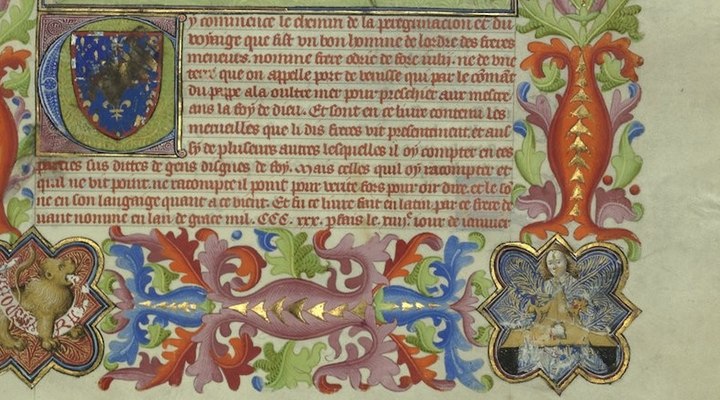
Credits: Parigi, BNF fr. 2810 – gallica.bnf.fr / Bibliothèque nationale de France