



Eventi
Eventi
23 Aprile 2026 dalle 13:30 alle 14:05
THE ROLE OF URBAN V’S IMAGES IN POLITICAL PROPAGANDA DURING THE GREAT SCHISM. Relazione della prof.ssa Claudia Bolgia al Convegno Internazionale ed Interdisciplinare: Solving the Schism: Empire and Papacy in the Vortex of Change, 1378–1417
Praga, Husova, 4a - Czech Academy of Science, Academic Conference Centre — Il 23 Aprile
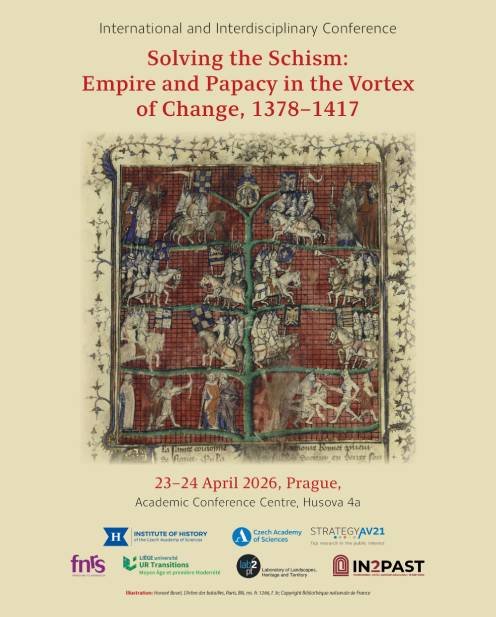
Nell'ambito della Conferenza Internazionale e Interdisciplinare: "Solving the Schism: Empire and Papacy in the Vortex of Change, 1378–1417" in programma a Praga dal 22 al 25 aprile 2026, la prof.ssa Clauda Bolgia, ordinaria di Storia medievale presso il DIUM, terrà una relazione sul tema: The Role of Urban V’s Images in Political Propagandaduring the Great Schism di cui si riporta il seguente abstract in inglese :
In various and many churches, including the patriarchal ones within the city ofRome and in other metropolitan sees, the cathedrals and conventual churches, the collegiate and non-collegiate churches, and in many other public and private places in the aforesaid locations, lands and regions from the devotion of the many different peoples devoted to God and to the Lord Urban himself, his image and images or effigies were and are painted and, from day to day, are still being painted’. With these words, the postulator Olivier in 1382 communicated the news of the widespread dissemination of images of Pope Urban V (1362– 1370) throughout Western Europe. This might seem like an exaggeration, yet the exceptionally high number of surviving images of this pontiff – datable mainly to the period between the late 1370s and around 1420 – suggests that there was far more than a mere kernel of truth in these words. Among medieval popes who were not elevated to sainthood, Urban V was the one for whom the greatest number of portraits was produced.
Traditionally interpreted as part of a process of ‘canonization through images’, many of these portraits – and the corresponding ‘visual canonization’ – should instead be reconsidered in light of the role they played during the Great Schism, namely in shaping, expressing, and advertising alliances with the Roman party and in reinforcing its power and authority.