

LACUNAE
Research
LACUNAE
Per l’integrazione automatica delle lacune epigrafiche greche e latine
Responsabili scientifici: Stefano Magnani, Maddalena Luisa Zunino
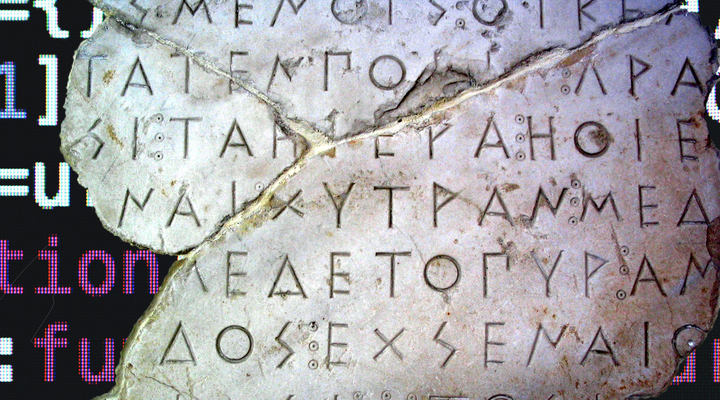
The LACUNAE project is dedicated to the creation of a digital tool that uses AI to generate suggestions for the integration of lacunae in epigraphic documents (primarily Greek and Latin), with attention paid both to the linguistic-literary aspects and to the material and iconographic aspects of the document, which is at the same time a monument.
Objectives
With regard to the linguistic aspects (including the exploration of the possibility that the suggestion may also be based on literary texts), tests are being carried out on the most recent NLP tools currently available to classical philology and epigraphy (such as Ithaca and Aeneas, the now numerous ‘derivatives’ of Latin BERT and Ancient Greek BERT, and the more recent Large Language Models), with attention also devoted to the issue of intertextuality.
With regard to the material and iconographic aspects, which concern both the exact calculation of the space occupied by the lacuna and the iconographic elements of an epigraphic text, the techniques made available by Computer Vision (CV) are being tested.
Results in the field of DH
Some more general issues relating to the application of AI to Latin inscriptions were presented at the 19th IRCDL (The Conference on Information and Research Science Connecting to Digital and Library Science, February 23—24, 2023, Bari, Italy: A. Locaputo, B. Portelli, E. Colombi, G. Serra, Filling the Lacunae in Ancient Latin Inscriptions, ceur-ws.org/Vol-3365/short5.pdf).
Moreover, again in relation to Latin inscriptions, the first results of the project were presented at the 2nd Workshop on Artificial Intelligence for Cultural Heritage, IAI4CH 2023, Rome, 6 November 2023 (CEUR Workshop Proceedings 3536): A. Brunello, E. Colombi, A. Locaputo, S. Magnani, N. Saccomanno, G. Serra.
Further developments were devoted to a chapter in the volume Decoding Cultural Heritage. A Critical Dissection and Taxonomy of Human Creativity through Digital Tools, edited by F. Moral-Andrés, E. Merino-Gómez, P. Reviriego, Cham, Springer.
The project also participated in the VIII Workshop of the international association Epigraphy.Info (Berlin, 3–5 April 2024), with the presentation of a poster (S. Magnani, D. Redaelli and A. Locaputo) and a paper (M.L. Zunino, V. Mignosa and A. Locaputo, A. Brunello, N. Saccomanno and G. Serra), the contents of which were expanded and reworked into a paper currently under review at the journal DSH; as well as, with regard to the Greek component, at the IX Advanced Seminar of Greek Epigraphy (SAEG IX, Rome, 8–10 January 2025: M.L. Zunino and V. Mignosa), whose contribution – relating to activities that on the Computer Vision side also involve G.L. Foresti, S. Zottin and A. De Nardin – will shortly be published in the SAEG Papers (https://www.saeg-papers.it).
The application of these same CV techniques has finally given rise, in the field of Latin inscriptions, to a branch of the project entitled EpiSignum, aimed at the creation of a manually annotated dataset of Late Antique Christian inscriptions.
The project and its initial results were presented at the 4th International Conference on Visual Pattern Extraction and Recognition for Cultural Heritage Understanding, Pescara, 3–4 December 2025 (VIPERC 2025).
The project activities will take part in the Panel Methods of identifying workshops in Greek and Latin epigraphy, from pen and paper to the latest digital techniques, on the occasion of the 17th International Congress of Greek and Latin Epigraphy (CIEGL), to be held in Bologna from 30 August to 4 September 2027.
Publications
- A. Locaputo, B. Portelli, E. Colombi, G. Serra, Filling the Lacunae in ancient Latin inscriptions, in 19th IRCDL (The Conference on Information and Research Science Connecting to Digital and Library Science), February 23—24, 2023, Bari, Italy (ceur-ws.org/Vol-3365/short5.pdf).
- A. Brunello, E. Colombi, A. Locaputo, S. Magnani, N. Saccomanno, G. Serra, Usage of Language Model for the Filling of Lacunae in Ancient Latin Inscriptions: A Case Study, in R. Damiano, S. Ferilli, M. Striani, G. Silvello (Eds.), 2nd Workshop on Artificial Intelligence for Cultural Heritage, IAI4CH 2023, Rome, 6 November 2023, Rome, CEUR-WS (CEUR Workshop Proceedings 3536), 2023, 113–125 (https://ceur-ws.org/Vol-3536/).
- A. Locaputo, B. Portelli, S. Magnani, E. Colombi, G. Serra, AI for the Restoration of Ancient Inscriptions: A Computational Linguistics Perspective, in F. Moral-Andrés, E. Merino-Gómez, P. Reviriego (Eds.), Decoding Cultural Heritage. A Critical Dissection and Taxonomy of Human Creativity through Digital Tools, Cham 2024, 137–154 (https://link.springer.com/book/10.1007/978-3-031-57675-1).
- A. Locaputo, M. Siderini, A. Brunello, S. Magnani, D. Redaelli, N. Saccomanno and G. Serra, EpiSignum: Taxonomy and Annotated Dataset for Symbol Recognition in Late Antique Latin Inscriptions, in 4th International Conference on Visual Pattern Extraction and Recognition for Cultural Heritage Understanding, Pescara, 3–4 December 2025 (VIPERC 2025), forthcoming (CEUR Workshop Proceedings).
- M.L. Zunino, V. Mignosa, A. Locaputo, A. Brunello, N. Saccomanno and G. Serra, The LACUNAE Project. Performing AI on Archaic Greek Epigraphy (DSH, under review).
- M.L. Zunino, V. Mignosa, Epigrafia greca e intelligenza artificiale tra testo e documento. Il progetto Lacunae dell’Università di Udine (SAEGPapers, under review).
Related Events
23–24 February 2023 |
6 November 2023 |
3–5 April 2024
|
8–10 January 2025 |
3–4 December 2025 |
Future events 30 August – 4 September 2027 |
Image: Dan Diffendale – CC BY-NC-SA 2.0